Skip to content
CaseOps is onboarding its first litigation chambers directly.Book a demo
Security
CASEOPS
Log inBook a demo
Demo

Technology & Research

Pakistani legal AI, already working on live cases.

Litigation lawyers use CaseOps for Case records, hearings, research across Pakistani judgments and statutes, drafting and review, with every citation linked to a source the system opened. Next, we propose to create expert Pakistani legal data, strengthen citation checks, and evaluate Pakistani-adapted models and confidential deployment, with review by independent advocates planned.

Book a demoWatch the product demo
  1. 01Working legal-work platformCase records, hearings, the Case Vault, research, drafting and review in one workspace, with citations that open to the source the system read.In the product
  2. 02Expert Pakistani legal data and verificationOriginal datasets created by Pakistani lawyers, used to strengthen and measure citation checks beyond what the product enforces today.Planned engineering
  3. 03Specialist and confidential AIPakistani-adapted models that must earn each task, and a tested private deployment for institutions.Planned engineering

CaseOps today

Live
Since January 2026The web platform has served lawyers at thecaseops.com since January 2026, with regular releases.
In use
On live mattersPakistani litigators run real Cases on CaseOps: hearings, documents, research and drafts.
Native apps
iPhone and AndroidOn the App Store and Google Play for existing CaseOps workspaces. The iPhone app is for teams; Android also suits solo practitioners.

This is early adoption, not independent validation. We have not yet independently measured accuracy or time saved across firms.

  • Built today
  • Architecture
  • Limits today
  • What comes next
  • Validation
  • Deployment
  • Team

Built today

Already working: a legal-work platform, not a chatbot

Lawyers use CaseOps for the whole matter: the Case record and its documents, research and drafting over that record and Pakistani law, and review before anything is relied on or sent.

01

The Case record

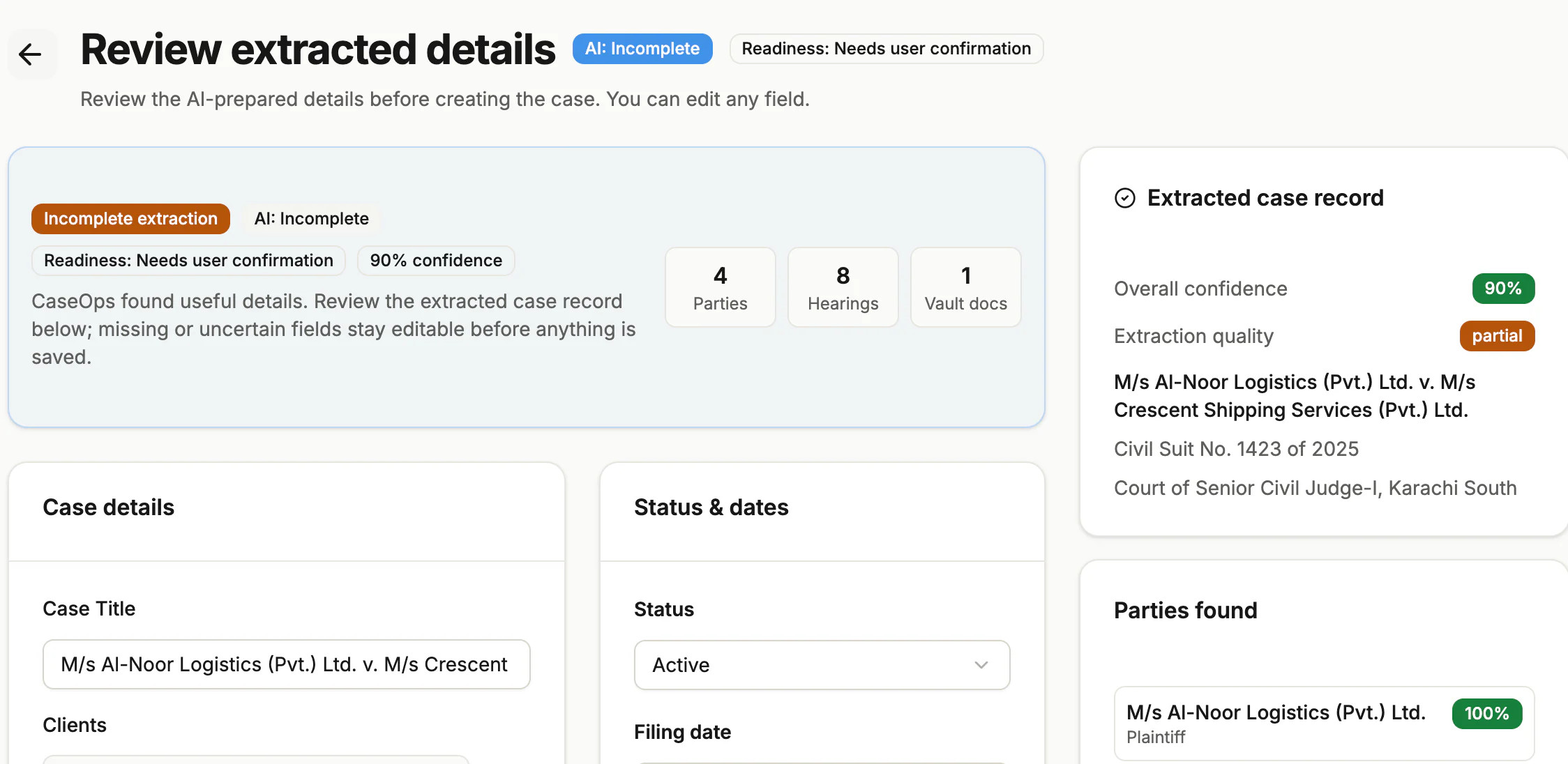
Clients, hearings, pleadings, orders and evidence sit in one Case record. Case Import reads uploaded papers and prepares the record for a lawyer to confirm before anything is saved.

Case Import review · synthetic Case
Case Import: an AI-prepared Case record awaiting a lawyer’s confirmation

Case Import reads the uploaded papers and proposes the Case, parties and hearings, with uncertain fields left for the lawyer to confirm or correct.

02

Research and drafting

Lawyers research the Case file, Pakistani judgments and statutes, generate a cited Dossier working brief and draft from the same evidence.

03

Sources and review

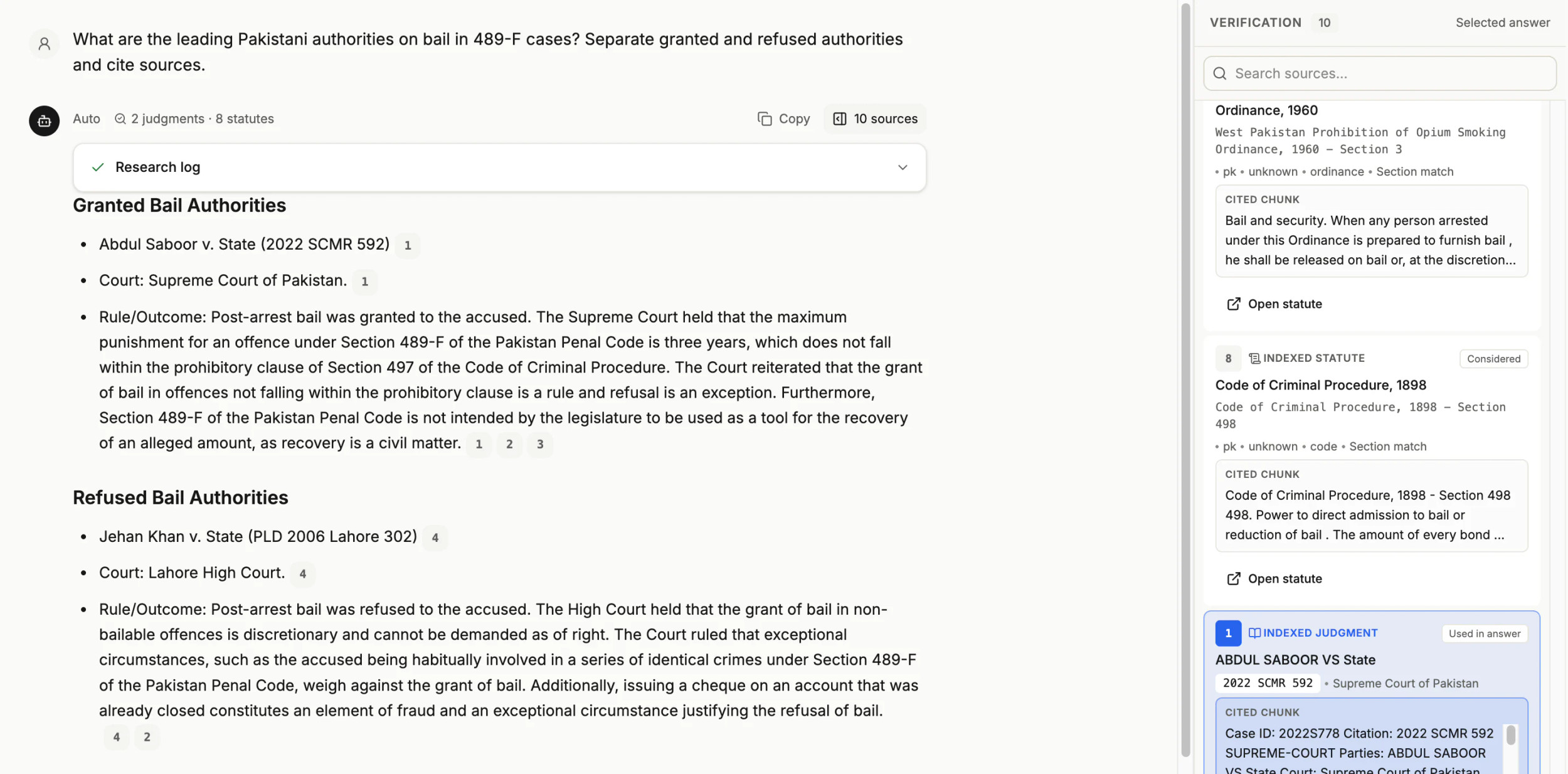
Each citation opens the passage it came from. A lawyer checks the work, and approves any client email, before anyone relies on it.

Research answer with its verification panel
A cited research answer in CaseOps

The panel lists the judgments and statutes the answer considered and used. Each opens to the passage it was cited for.

In the product

  • Cases, clients and hearings

    Matters, parties, clients, hearings and order sheets in one record, with next dates tracked and synced to calendars.

  • Case Vault and Case Import

    Private document storage with text extraction and search. Case Import builds a Case record from uploaded papers for a lawyer to confirm.

  • Dossier working brief

    A cited brief of the Case, its posture and the work ahead, generated in the background from the Vault, updated on request and downloadable in Word.

  • Matter-aware legal research

    Adaptive research over the authorised Case record, Pakistani judgments and statutes, and public web sources, with private Case details kept out of public web searches.

  • Drafting Workspace and CaseOps Review

    Drafts grounded in the Case record and the law, revised in conversation and exported to Word or PDF: built-in First Appeal and Reply skills, a general legal-document mode and lawyer-authored Skills. CaseOps Review audits a draft against its cited sources.

  • SourceLedger citations

    Citations resolve only to sources the research actually opened and admitted, and open to the passage relied on.

  • Durable AI work

    Long research, Dossier and drafting jobs run on background workers, recover from failures, can be cancelled and record which model ran.

  • Roles and approvals

    Principal, associate and clerk access enforced in the database by role and Case assignment. Client emails go out only after a lawyer approves the exact message.

  • Android app

    On Google Play for CaseOps workspaces: the court day, Case documents and saved Dossiers offline, cited Case answers, document scanning and client-update approval.

  • iPhone app

    The same native court-day app on the App Store, for CaseOps team workspaces with two or more active members.

Explore the platformCaseOps MobileWhere it stops today

Legal AI architecture

The application decides what a model may cite. The lawyer decides what to rely on.

Frontier models choose what to search and read, and do the legal reasoning. CaseOps controls what they may access, records what they actually read and lets them cite only that. Nothing is cited from outside what the research opened and admitted to the SourceLedger.

  • CaseOps enforces
  • AI model works
  • Lawyer decides
1Authorised Case context
2Source discovery and reading
3Source admission
4AI legal work
5Citation resolution
6Lawyer verification
  1. 1

    Authorised Case context

    CaseOps enforces

    Each request starts from a lawyer, an organisation and often a Case. Access is checked in the database before any model runs.

    Only what this lawyer may see is reachable.

  2. 2

    Source discovery and reading

    AI model works

    The model searches the Case record, Pakistani judgments and statutes, and public web sources step by step, and opens what it needs.

    Private Case details stay out of public web searches. Every passage the model reads is recorded.

  3. 3

    Source admission

    CaseOps enforces

    Opened sources enter the SourceLedger with their identity, the passages read and a content fingerprint.

    Only admitted sources can be cited. A search snippet never can.

  4. 4

    AI legal work

    AI model works

    A frontier model writes the analysis or draft, citing only by reference IDs CaseOps issued for passages it read.

    A model cannot invent a source and have it shown as a citation.

  5. 5

    Citation resolution

    CaseOps enforces

    Each citation is resolved against the SourceLedger before the lawyer sees it. Anything outside it is removed.

    Every citation shown opens to an admitted source.

  6. 6

    Lawyer verification

    Lawyer decides

    The lawyer opens the sources, checks the reasoning and decides what is relied on, filed or sent.

    Legal judgement, and approval of anything sent to a client, stay with the lawyer.

The application sets the boundaries, admits sources and resolves citations. Frontier models choose what to read and do the legal reasoning inside those boundaries. The lawyer decides what is relied on. Each check marks what CaseOps enforces or records at that stage.

What narrows on the way to a citation

Authorised case file and lawRetrievedOpened and readAdmitted to SourceLedgerCited, then reviewed by a lawyer
Each line is a document or authority. Most of what a lawyer may access is never retrieved, and only sources that were opened and admitted can be cited. Each question takes its own path through the material. Illustrative, not measured.

Limits today

Provenance is not correctness

Behind every citation sit four different guarantees. CaseOps enforces the first on every citation, checks the second in specific workflows and leaves the third and fourth to the lawyer today. A citation that resolves proves where the words came from. It does not prove that the legal conclusion is right.

The guaranteeToday in CaseOpsProposed next
  1. 1

    Genuine, opened source

    Does the citation resolve to a source the system actually opened?

    Enforced on every citation

    Checked automatically by the SourceLedger. Anything that does not resolve is removed before the lawyer sees it.

    Carried forward

    Stays a hard rule for every new workflow and every model, including any adapted model.

  2. 2

    Passage supports the point

    Does the cited passage support the proposition it is attached to?

    Checked in specific workflows

    CaseOps Review re-opens a draft’s cited sources and reports propositions they do not support, and strategy answers are audited claim by claim. Coverage is not universal and accuracy has not been independently measured; the lawyer still verifies.

    Planned engineering

    A first support check inside CaseOps research, then measured improvement against lawyer-labelled passage and proposition pairs.

  3. 3

    Authority still applies

    Has a later judgment followed, distinguished or overruled it?

    Left to the lawyer today

    Research can be asked to look for later judgments treating a named authority, but CaseOps is not a citator and makes no good-law determination.

    Planned engineering

    Lawyer-labelled treatment data, starting with Supreme Court and Lahore High Court judgments, to find and describe later and adverse treatment more reliably.

  4. 4

    Right version of the law

    Was the text in force at the relevant time applied?

    Left to the lawyer today

    Research can be directed to a historical period, but the statute corpus is not yet a version history.

    Planned engineering

    Selected historical versions of key federal and Punjab laws, linked to their sources, so research can tell which text applied when.

Where else CaseOps stops today

  • Models

    All AI work runs on frontier models from approved providers. No CaseOps-adapted model is in the product.

  • Handwritten orders

    A general multimodal model reads order sheets. Handwritten Urdu is detected and its confidence capped, and the summary is labelled to be checked against the order.

  • Coverage

    In development

    Drafting covers built-in skills and a general legal-document mode, not every filing. Research that reads more of the record, and drafting across more documents, are being improved now.

  • Deployment

    CaseOps runs only as a managed cloud service. There is no private or on-premises deployment, and no security certification yet.

  • Measurement

    Accuracy, citation support and time saved have not been independently measured.

Research and development

Advancing Pakistani legal intelligence

The next stage is a defined engineering and validation programme aimed at those limits: original Pakistani legal data created by professionals, used to strengthen and measure citation checks, adapt specialist models and test them independently. It is proposed work, and it depends on funding.

In the product
Implemented and in use in the product today.
Internal testing
Implemented, with internal testers only. Not publicly released.
In development
Implementation work is under way. Not yet released.
Planned engineering
A defined engineering and validation deliverable we have proposed. Not yet built and not offered.
Longer-term opportunity
An ambition beyond the planned programme.

Expert-created Pakistani legal data

Planned engineering

We plan to pay qualified Pakistani lawyers and transcribers to create original training and evaluation material, so quality is measured against practitioners rather than assumed. Proposed scopes; none of these datasets exists yet.

  • Handwritten court orders

    3,000 verified pages

    Urdu and English order sheets transcribed and checked, with key dates and directions, and uncertain readings marked rather than guessed.

    A misread date or direction changes what a lawyer does next.

  • Senior-advocate legal-work packages

    An initial 60, more only if results justify it

    Each a case file with a sound draft, strong and weak grounds, the relevant authorities and a grading rubric, prepared by senior litigators.

    Professional quality has to be defined by practitioners before it can be measured.

  • Citation-support and treatment labels

    Supreme Court and Lahore High Court judgments first

    Lawyer labels of whether a passage supports a stated proposition, and of how later judgments treated an authority.

    Support and treatment checks need ground truth from lawyers.

  • Historical versions of legislation

    Selected key federal and Punjab laws

    Earlier texts linked to their sources, so research can tell which version applied when.

    Older facts are often governed by amended or repealed text.

Rights, consent and licensing come first

  • A data-rights and consent protocol comes first, with counsel’s opinion on using public judgments, statutes and court records for search and AI training.
  • Documents a firm shares are used only with its written consent and redaction, and nothing confidential is published.
  • Data with restricted rights is used for search only, and a register records the source and licence of every dataset and model.
  • Created through paid professional work: junior lawyers transcribe and label, practising advocates review, senior litigators set the grading standard.

Pakistani-adapted models

Planned engineering

Specialist models that have to earn each task

Today frontier models from approved providers do all AI work in CaseOps. No CaseOps-adapted model is in the product, and none would replace frontier models across the board.

  1. 1

    Adapt

    Start from openly licensed base models whose licences permit commercial use, and adapt them with the expert-created Pakistani legal data.

  2. 2

    Start narrow

    Begin with one narrow task where specialist adaptation may help, such as reading handwritten orders or a bounded verification step.

  3. 3

    Compare

    Test each adapted model against leading international models on the same Pakistani legal tasks: accuracy and serious errors first, then cost and speed.

  4. 4

    Expand on evidence

    Take on more tasks, or train a larger model, only where measured results justify it.

  5. 5

    Keep the better model

    Frontier models stay wherever they give lawyers the better result for the cost.

Policy direction
“Preference shall be given to the use of locally developed explainable AI systems trained on Pakistani legal data to avoid potential biases and associated challenges.”

National Guidelines for Use of Artificial Intelligence in Judicial Institutions of Pakistan, section 5.5 (opens in a new tab), National Judicial (Policy Making) Committee.

These guidelines govern AI in judicial institutions. We read section 5.5 as the policy direction that makes Pakistani specialist-model work relevant, not as a requirement on lawyers or a procurement rule, and not as an endorsement of CaseOps or of any model we offer.

Adapting an openly licensed model does not create a Pakistani foundation model. The Pakistani contribution is the professional legal data, the adaptation and evaluation, and the reliability and deployment engineering around it.

On-device models

Longer-term opportunity

Small models on the lawyer’s own device

Some legal work is short and needs an answer at once: sorting a scanned page, naming a document, drafting a brief reminder for the lawyer to approve. We plan to explore small models that run on the lawyer’s own phone or computer for tasks like these.

Nothing runs on the device today. Every AI request in CaseOps goes to a cloud model.

Models built into the device
Some phones and computers now include on-device models, such as Apple’s. Where a device offers one, CaseOps could use it for short, bounded tasks.
Small open models, downloaded
Small openly licensed models could be downloaded to a capable device, so those tasks keep working without a connection.

What it could offer

  • Lower latency, with no round trip to a cloud model.
  • Tasks that keep working offline.
  • No per-request cloud AI call for those steps, and the text they read need not leave the device.

Small models are less capable than frontier models. They would take narrow tasks only, pass the same evaluation before release, and depend on each device’s memory, storage and operating system. Frontier models stay wherever they give the better result.

Document intelligence, applied

Handwritten Urdu and English court orders

Pakistani courts still write many order sheets by hand. The expert data is meant to make reading them measurably reliable, without guessing at what cannot be read.

In the product
When an order sheet is uploaded to a hearing, a frontier multimodal model summarises it and suggests a next date for a person to confirm. Handwritten Urdu is detected, its confidence is deliberately capped and the summary is labelled to be checked against the order.
Planned engineering
Verified transcriptions used to measure and improve extraction: uncertain readings flagged rather than guessed, and every extracted date or direction linked to its place on the page.
See the transcription concept

Synthetic illustration. Not a real court order, and not output from a working system.

ORDER SHEETIn the Court ofCase No.No.DateOrder with signature12345

The original image, with each region the transcription links back to.

Transcription

Extracted for the lawyer to check

How the proposed work is sequenced

  1. 01Baseline

    A data-rights and consent protocol. Independent advocates grade CaseOps and general AI tools on Pakistani tasks. A first passage-support check inside CaseOps research, and a first small model adapted to one narrow task.

  2. 02Expert data

    The first handwritten-order pages and senior-advocate packages, and treatment and law-version data, with the improved checks integrated into CaseOps.

  3. 03First blind review

    Adapted models, leading international models and improved CaseOps workflows compared on appeals, drafting and multi-document analysis, then a decision on evidence about what to expand.

  4. 04Private deployment

    A security-tested reference environment for institutions, with approved AI services or fully private processing, and a view across cases handled by outside firms.

  5. 05Field validation

    Validation with paying firms in Lahore, Islamabad and Karachi, and independent security testing. An institutional pilot only if a partner signs.

  6. 06Independent results

    A second blind review, reproducible test results, private-deployment documentation and measured adoption.

A proposed sequence, not a release schedule. It depends on funding, and each step goes ahead only if the one before justifies it.

Independent validation

Judged on legal work a lawyer accepts, not on demos

Internal regression and replay evaluations guide our development today. The planned programme adds advocates outside CaseOps, blind comparisons and field validation with paying firms. Every model, frontier or specialist, is measured on the same tasks. Cheap and fast only matter once the work is right.

  1. 01Independent advocate-graded baseline

    Advocates outside CaseOps grade CaseOps and general AI tools on Pakistani legal tasks before any improvement is credited.

  2. 02Blind comparisons of legal work

    Advocates grade work without knowing which system produced it, on a Pakistani legal test set. Part of the test set will be published under an open licence.

  3. 03Citation accuracy and lawyer acceptance

    Whether each citation resolves, and whether its passage supports the statement, scored separately. How often lawyers accept the work, and how long correcting it takes.

  4. 04Model accuracy, latency and cost

    Accuracy and serious errors first, including dates and directions read from handwritten orders. Then waiting time, reliability and cost per accepted work product.

  5. 05Field validation with firms

    With paying firms, each against its own starting point: time per task, accepted work, missed or late updates, and whether firms keep paying.

  6. 06Security testing and certification work

    Independent penetration testing of the platform and mobile apps, testing the AI for misuse and for leaks between Cases and organisations, and work towards ISO/IEC 27001.

The measure that decides between models

Cost per accepted work product

Everything spent: models, retries, infrastructure and lawyer review

Work a lawyer accepts as correct and source-supported

A cheaper model that produces more rejected work is not cheaper. Every model, including the frontier models CaseOps uses today, is measured the same way.

When a specialist model takes over a task

  1. A candidate model for one specific task
  2. Tested on the same Pakistani legal tasks as the current model
  3. No more serious errors, and cheaper or faster per accepted result?
  4. YesIt takes that taskNoThe current model stays

Being developed locally is never a reason to promote a model. It has to meet the same accuracy and serious-error standard.

No independent evaluation has run yet, and we publish no benchmark results. We will report numbers once independent reviews have run. They are worth running even if international models outperform our own adapted ones: the same tests measure the quality of every CaseOps workflow.

Deployment and institutional choice

From managed cloud today to a boundary an institution controls

Banks, insurers, companies and public bodies often need control over where their legal records are stored, read, searched and reasoned over, what is logged, and what may leave their network. CaseOps runs one way today. The two private options are proposed engineering: a working, security-tested reference environment first, and an institutional pilot only with a signed design partner. Neither is offered today.

Who runs each layer of a legal AI request today, and in the two proposed private institutional deployment options
TodayProposed private institutional deployment
01CaseOps cloudManaged CaseOps cloudHow CaseOps works todayIn the productHow CaseOps works today02Approved AIInstitution environment with approved AI servicesProposed. Not offered todayPlanned engineeringProposed. Not offered today03Fully privateFully private processingProposed. Not offered todayPlanned engineeringProposed. Not offered today
Case recordsCase files, drafts and documentsCaseOpsCaseOps cloudInstitutionInstitution boundaryInstitutionInstitution boundary
Document processingText extraction and OCRCaseOpsCaseOps cloudProviderApproved AI serviceInstitutionInstitution boundaryProviderApproved AI serviceInstitutionInstitution boundary
SearchIndexing and retrievalCaseOpsCaseOps cloudProviderApproved AI serviceInstitutionInstitution boundaryInstitutionInstitution boundary
Model inferenceReasoning and draftingProviderApproved AI serviceProviderApproved AI serviceInstitutionInstitution boundary
Background workersQueued AI workCaseOpsCaseOps cloudInstitutionInstitution boundaryInstitutionInstitution boundary
Logs and monitoringDiagnostics and tracesCaseOpsCaseOps cloudProviderApproved AI serviceInstitutionInstitution boundaryInstitutionInstitution boundary
BackupsCopies and recoveryCaseOpsCaseOps cloudInstitutionInstitution boundaryInstitutionInstitution boundary
Network egressWho decides what leavesCaseOpsCaseOps cloudInstitutionInstitution boundaryInstitutionInstitution boundary
  1. 01Managed CaseOps cloud. CaseOps runs on managed cloud infrastructure and calls frontier models through approved enterprise AI services: Microsoft Azure, Google Cloud Vertex AI and Amazon Bedrock. Its access and confidentiality controls apply throughout.
  2. 02Institution environment with approved AI services. CaseOps inside an environment the institution controls. Records, search, jobs, logs and backups stay inside; model calls go to global AI services the institution approves under its own contract.
  3. 03Fully private processing. Every step inside the agreed boundary, from reading scans to search, the model, background jobs, logs and backups, with a CaseOps-adapted model or the institution’s own, tested for leaks between organisations and Cases.
Today every request follows the first column. The second and third columns are proposed architecture, not services CaseOps offers. With approved AI services, model calls leave the institution under its own contract. Fully private processing has to hold the boundary for every row, including background workers, logs and backups.

How CaseOps handles data today

  • Customer documents, prompts and outputs are not used to train models. Any future use of material a firm shares, for datasets or model adaptation, would need its written consent.
  • Approved AI services receive only the information a feature needs, under enterprise terms. That is provider-approved enterprise AI, not private inference.
  • Access is controlled by organisation, role and Case assignment, enforced in the database.
  • CaseOps does not offer self-hosted, on-premises or sovereign deployment today, and holds no security certifications.
Security and data handling

Two different promises

Approved enterprise AI and fully private inference are different promises. The first sends model calls to a provider under contract. The second keeps the model itself inside the institution’s boundary.

We will keep using frontier providers wherever they give lawyers the better result for the cost. A specialist model is not automatically cheaper, better or more private.

Team and ecosystem

An engineer and a litigator, building from Lahore

CaseOps pairs production software and AI engineering with day-to-day Pakistani litigation practice in the same founding team.

Hamza Liaqat

Co-Founder & CEO

  • BS Computer Science, LUMS. Author of Practical Machine Learning.
  • More than seven years designing and shipping production software. Leads engineering, and built the platform and both native apps with Hammad.
  • Previously technical lead on the modernisation of Australia’s Modern Slavery Statements Register, delivered as a contractor through GoSource Australia.
Engineering portfolio

Hammad Hussain Shah

Co-Founder & COO

  • BA-LLB, LUMS. Advocate of the High Court.
  • Practising Pakistani litigator, Senior Associate at Axis Law Chambers.
  • Leads legal design, testing and sales, so CaseOps workflows follow how litigation is actually run.
About the founders
  • NVIDIA Inception program member (opens in a new tab)
  • NIC Lahore (opens in a new tab)

Member of NVIDIA Inception. Incubated at NIC Lahore, Cohort 4.

CaseOps (Private) Limited, incorporated in Lahore in 2026. The founders have built the platform and both native apps themselves since July 2025.

Programme membership is not investment in CaseOps, and not certification or endorsement by any provider.

Where this is going

Pakistan first. Built to travel.

Our ambition is legal AI with the breadth and rigour of the leading international platforms, made affordable and accessible for Pakistani lawyers first, and later for other legal systems that imported tools overlook.

For law firms
Legal work a lawyer can check, with a measured cost and correction time for each piece of work a lawyer accepts.
For institutions
Stronger confidentiality options and reliable status, deadlines and reporting across cases handled by many outside firms.
  1. Now

    In the product

    A working legal-work platform used on live Pakistani litigation matters, with source-linked research, a cited Dossier, drafting, lawyer review and native iPhone and Android apps.

  2. Next

    Planned engineering

    Expert Pakistani legal data, stronger citation checks, adapted models tested against international ones and a tested private deployment, each validated by independent advocates.

  3. Later

    Longer-term opportunity

    Institutional deployments with design partners, oversight across the outside firms an institution instructs, and other legal systems that imported tools overlook.

What we are not claiming

  • CaseOps does not run a self-hosted or CaseOps-trained legal model in production.
  • We have not shown parity with frontier models or with any other legal AI product, including the leading international platforms.
  • The expert datasets, adapted models, private deployment and independent evaluation described here are proposed work. None is complete or offered today.
  • Use on live matters is early adoption. It is not independent validation across firms.
  • We do not own the court judgments we search, or claim rights to train on commercial legal databases.
  • CaseOps makes no automated good-law determinations and is not a citator.
  • CaseOps serves Pakistani law. We do not offer validated coverage of other jurisdictions.
Book a demoExplore the platform

Research or technical collaboration? Email Hamza Liaqat.

CASEOPS

Turn case files into AI workspaces for legal work — source-backed, reviewable, built for chambers.

Product

Platform overviewDraftingCaseOps MobileCase File IntakeDossier working briefLegal workSource verificationHearings & order sheetsChamber workspace

Solutions

Litigation chambersSecurity & trustPricing

Company

AboutTechnology & ResearchFAQBlogContact

Legal

Privacy policyTerms of service

© 2025 CaseOps. All rights reserved.

Built for lawyer review, not blind reliance.

CaseOps is a member of the NVIDIA Inception program. NVIDIA and the NVIDIA logo are trademarks and/or registered trademarks of NVIDIA Corporation in the U.S. and other countries.